Science
Our Vision
At Stephen A. Halsey JHS 157, the vision of the Science Department is to ignite a passion for scientific discovery by fostering a learning environment where every student becomes a critical thinker, problem solver, and informed global citizen. Guided by the Next Generation Science Standards (NGSS), we are committed to implementing phenomena-based learning that encourages students to explore real-world events and apply scientific reasoning to make sense of the world around them. Through hands-on investigations, engineering practices, and the integration of crosscutting concepts across disciplines, our classrooms promote deep understanding, creativity, and inquiry. We aim to prepare our students for success throughout middle school and beyond by building a strong foundation in science literacy and fostering environmental awareness. By nurturing a love of science and encouraging active participation, we strive to create a dynamic and inclusive learning community where all students feel empowered to explore, question, and innovate.
Curriculum Overview
🔬 Grades 6–8: General Science
Students in grades 6 through 8 engage in a comprehensive curriculum that emphasizes:
-
Phenomena-based learning that connects classroom lessons to real-world experiences
-
Three-dimensional learning through disciplinary core ideas, science and engineering practices, and crosscutting concepts
-
Use of explicit vocabulary instruction, text-based evidence, and reading comprehension strategies to build fluency in scientific language
-
Regular use of labs, investigations, and hands-on experiences to promote inquiry, collaboration, and critical thinking
Topics covering core domains, including:
-
Physical Science (matter, energy, forces, and motion)
-
Earth and Space Science (geology, weather, climate, astronomy)
-
Life Science (cells, ecosystems, heredity, body systems)
-
Engineering Design (problem-solving, prototyping, and evaluating solutions)
ILS Required Investigations
| Investigation Title | Focus Area | Aligned Standard(s) |
|---|---|---|
| How’s the Weather Up There? | Weather patterns and atmospheric phenomena | MS-ESS2-5, MS-ESS2-6 |
| All Mixed Up | Properties of matter and physical changes | MS-PS1-1, MS-PS1-4 |
| Cool It! | Heat transfer and temperature changes | MS-PS3-3, MS-PS3-4 |
| It’s Alive? | Characteristics of living things and basic biology | MS-LS1-1, MS-LS1-2 |
| 📊 General Science Grades 6-8 Grading Policy |
|
🔬8th Grade Honors – Life Science: Biology Regents
Our 8th Grade Honors students take Life Science: Biology, a New York State Regents course typically offered in high school. This rigorous program prepares students for advanced science study and includes:
-
Full-year high school Regents curriculum in Life Science
-
Topics include: cells and cellular processes, genetics, evolution, human body systems, reproduction, ecology, and scientific inquiry
-
Emphasis on lab-based learning to reinforce theoretical knowledge
NYS Biology Required Investigations
| Investigation Title | Focus Area | Aligned Standard(s) |
|---|---|---|
| Balancing Act | Homeostasis and feedback mechanisms in organisms | HS‑LS1‑3 |
| The Mystery of Lactose Intolerance | Inheritance of traits, gene expression, and molecular biology | HS‑LS3‑3, HS‑LS1‑1 |
| For the Birds – Designing Solutions | Ecosystem interactions and engineering solutions to real-world problems | HS‑LS2‑7 |
Required Lab Hours:
In accordance with New York State Education Department (NYSED) requirements, students must complete a minimum of 1,200 minutes (20 hours) of hands-on laboratory experience, accompanied by documented lab reports, to be eligible to take the Biology Regents Exam in June.
| 📊 Biology: Life Science Regents Grade 8 Grading Policy |
|
THE THREE DIMENSIONS OF SCIENCE LEARNING
Within the Next Generation Science Standards (NGSS), there are three distinct and equally important dimensions to learning science. These dimensions are combined to form each standard or performance expectation, and each dimension works with the other two to help students build a cohesive understanding of science over time.
Crosscutting Concepts 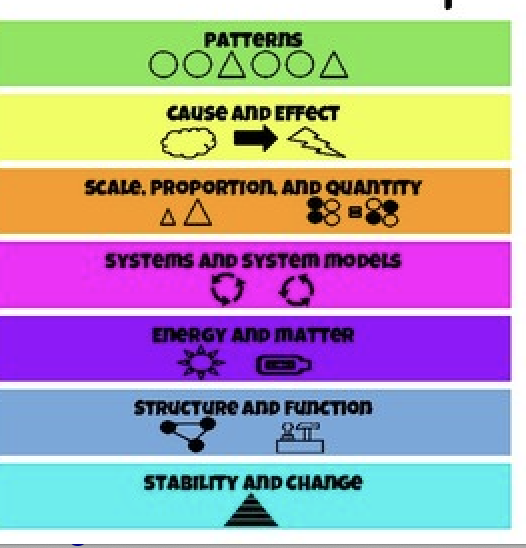
Crosscutting Concepts help students explore connections across the four domains of science, including Physical Science, Life Science, Earth and Space Science, and Engineering Design. When these concepts, such as “cause and effect”, are made explicit for students, they can help students develop a coherent and scientifically based view of the world around them.
Science and Engineering Practices 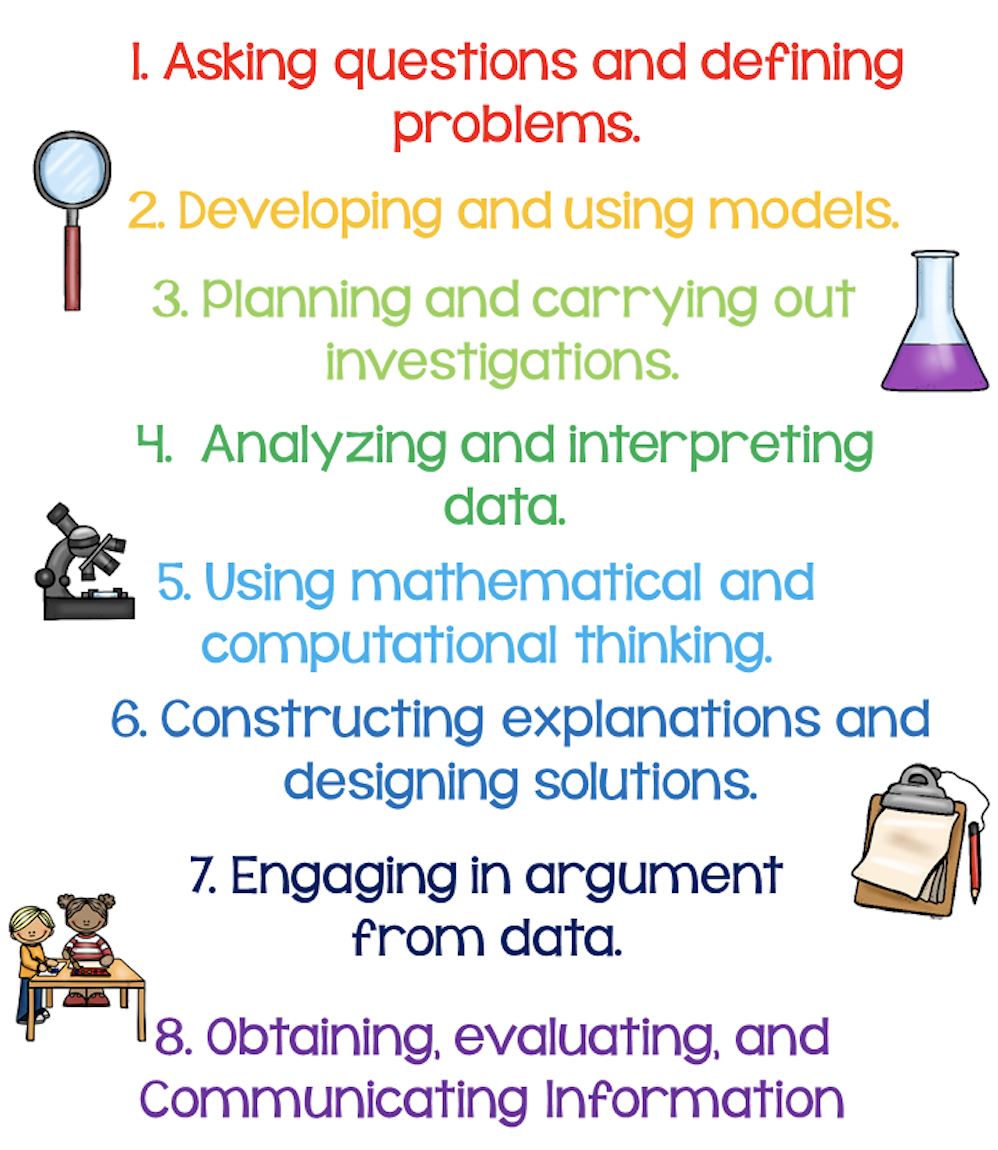
Disciplinary Core Ideas 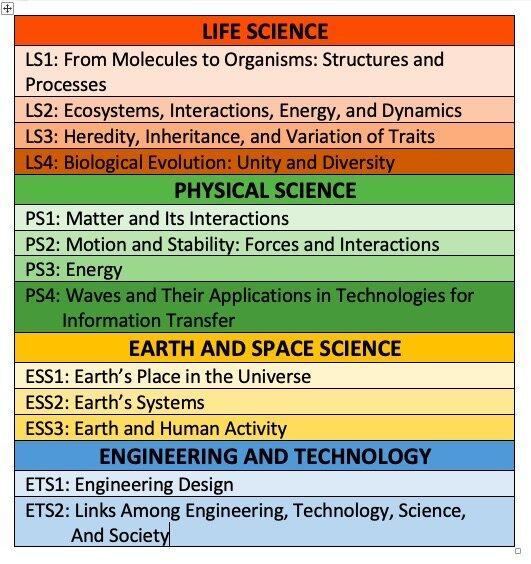
👨👩👧👦 How Parents Can Help at Home
-
✔️ Check Google Classroom weekly for assignments and updates
-
🧠 Ask about what they’re learning and the problems they’re solving
-
🔧 Support the Engineering Design Process: Ask → Imagine → Plan → Create → Test → Improve
-
📚 Help study for quizzes/tests: review notes, use flashcards, explain concepts, study a little daily
-
🛠️ Help with projects: gather materials and give time to work
-
🌍 Connect science to everyday life (cooking, weather, nature)
-
📺 Watch science videos together (NASA STEM, SciShow Kids)
-
💬 Encourage effort and learning from mistakes
-
✉️ Contact the teacher for help when needed